
![Maharishi Ayurveda Europe B.V. [DE]](http://maharishiayurveda.de/cdn/shop/files/mape_logo_85x_2x_4fa3ad6c-821a-4738-8803-0b9e4fbd888e.webp?v=1776845850&width=150)

![Maharishi Ayurveda Europe B.V. [DE]](http://maharishiayurveda.de/cdn/shop/files/mape_logo_85x_2x_4fa3ad6c-821a-4738-8803-0b9e4fbd888e.webp?v=1776845850&width=600)

Dosha Knowledge
 2026 April 21

Vata, Pitta, Kapha – Doshas in Ayurveda
What You Should Know About Vata, Pitta, Kapha
Vata, Pitta and Kapha: This is what Ayurvedic health teachings call the three "Doshas" (regulatory forces), and they place extremely great importance on their harmony or balance.
But what exactly are Doshas? Ayurveda describes the Doshas as three fundamental forces or principles that pervade the entire cosmos, nature, and also humans, and thus control all bodily functions.
Humans as a Mirror of Their Dosha Balance
The individual distribution of the three Doshas determines our constitution or our Ayurveda type. It describes our mental and physical predispositions: our physique, our nutritional needs and our metabolism, as well as the different characteristics of our personality, our temperament, our likes and dislikes, our strengths and weaknesses.
Ayurveda Types
Depending on which Dosha(s) predominates, Ayurveda distinguishes between various constitutional or Ayurveda types: the Vata, Pitta, and Kapha types, as well as a number of mixed types.
Don't Know Your Ayurveda Type Yet? Free Dosha Test
Don't know your Ayurveda type yet? For a first insight, we recommend our free Dosha test.
Vata, Pitta, Kapha – How the Doshas Shape Us
1. Vata – the Principle of Movement
Vata is responsible for the nervous system, respiration and all movements in the body. The Vata Dosha is associated with the elements space and air. When Vata is balanced, one feels energetic, joyful, enthusiastic and creative; the mind is calm, clear and awake.
2. Pitta – the Metabolic Principle
Pitta regulates digestion and body temperature, among other things. In the mental sphere, it stands for a sharp intellect and emotions. Pitta consists primarily of the fire element. In balance, it provides contentment, energy, eloquence, good digestive power, the right body temperature and a clear mind.
3. Kapha – the Structural Principle
Kapha gives the body firmness and stability and keeps the fluid balance in equilibrium. The elements earth and water are assigned to it. A balanced Kapha provides strength, endurance, a good immune system, patience and psychological stability.
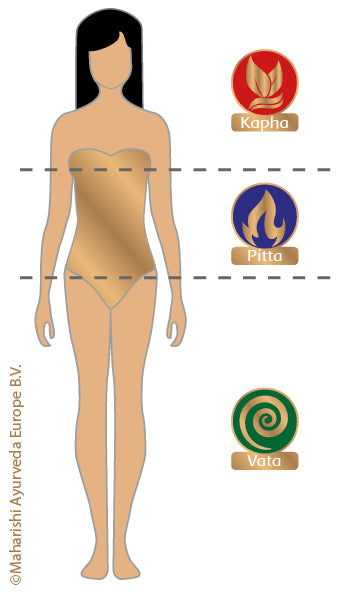
Distribution of Vata, Pitta & Kapha in the Body
Although all three Doshas are present in the body, the ancient Vedic texts describe a main seat for each of the Doshas.
"Vata is mainly found below the navel, Pitta mainly between the heart and navel, and Kapha above the heart."
– Ashtanga Hridayam, Sutrasthan 1.7
Maintaining Inner Balance
If the three Doshas are in their individual balance, this means that all bodily functions can proceed unimpeded – according to Ayurveda, we are then perfectly healthy and feel completely comfortable in our own skin. However, if the Dosha balance gets out of balance, diseases can develop in the long term.
Wisdom from Ancient Texts – How We Benefit from a Successful Dosha Balance
The foundational work of traditional Ayurvedic literature, the Charak Samhita, explains the importance of balanced Doshas: "The body of every living being is always the abode of Vata, Pitta and Kapha. One should know whether they are in a natural (balanced) or unnatural (unbalanced) state." – (Charak Samhita, Sutrasthan, 18.48)
What follows is a precise description of the effect of balanced Doshas. It states, for example, that a balanced Vata Dosha expresses itself through enthusiasm, well-functioning tissue metabolism and good elimination, among other things.
A balanced Pitta Dosha shows itself in good digestion and eyesight, it continues, in balanced body temperature, balanced hunger and thirst, as well as good radiance, happiness and intelligence.
Kapha in balance is described by strength, tolerance, patience and the absence of greed. – (Charak Samhita, Sutrasthan, 18.49-51)
Ojas – The Secret of Vitality & Strength
It is good, therefore, when the Doshas are in balance, because then the body is healthy and, according to Ayurveda, "Ojas" is created, the finest end product of digestion, which has such a fine structure that it is at once matter and consciousness.
Ojas is the totality of all three Doshas. Its properties promote vitality and strength, good health, preserve youthfulness and allow us to think positively. A person with a lot of Ojas feels completely happy and radiates this too. Externally, Ojas can be recognized, for example, by healthy, glowing skin and radiant eyes.
What can we do to maintain or regain the balance of the Doshas so that Ojas can be created?
On our website you will find plenty of tips and information for a healthy daily routine, dealing with the seasons, nutrition, work-life balance and much more.


Maharishi Ayurveda® knows 20 holistic approaches to maintaining or restoring Dosha balance, such as a suitable daily routine, nutrition or adapting to the seasons.
Would You Like to Support Your Health Even More Effectively?
Get personalized advice from an experienced Maharishi Ayurveda® expert – individually tailored to you and your needs.


